Artificial Intelligence-Assisted Drug Discovery for Neurodegenerative Diseases: Integration of Machine Learning, Molecular Docking, and Systems Pharmacology
DOI:
https://doi.org/10.64062/Keywords:
- artificial intelligence; machine learning; molecular docking; systems pharmacology; network pharmacology; neurodegenerative diseases; Alzheimer's disease; Parkinson's disease; drug discovery
Abstract
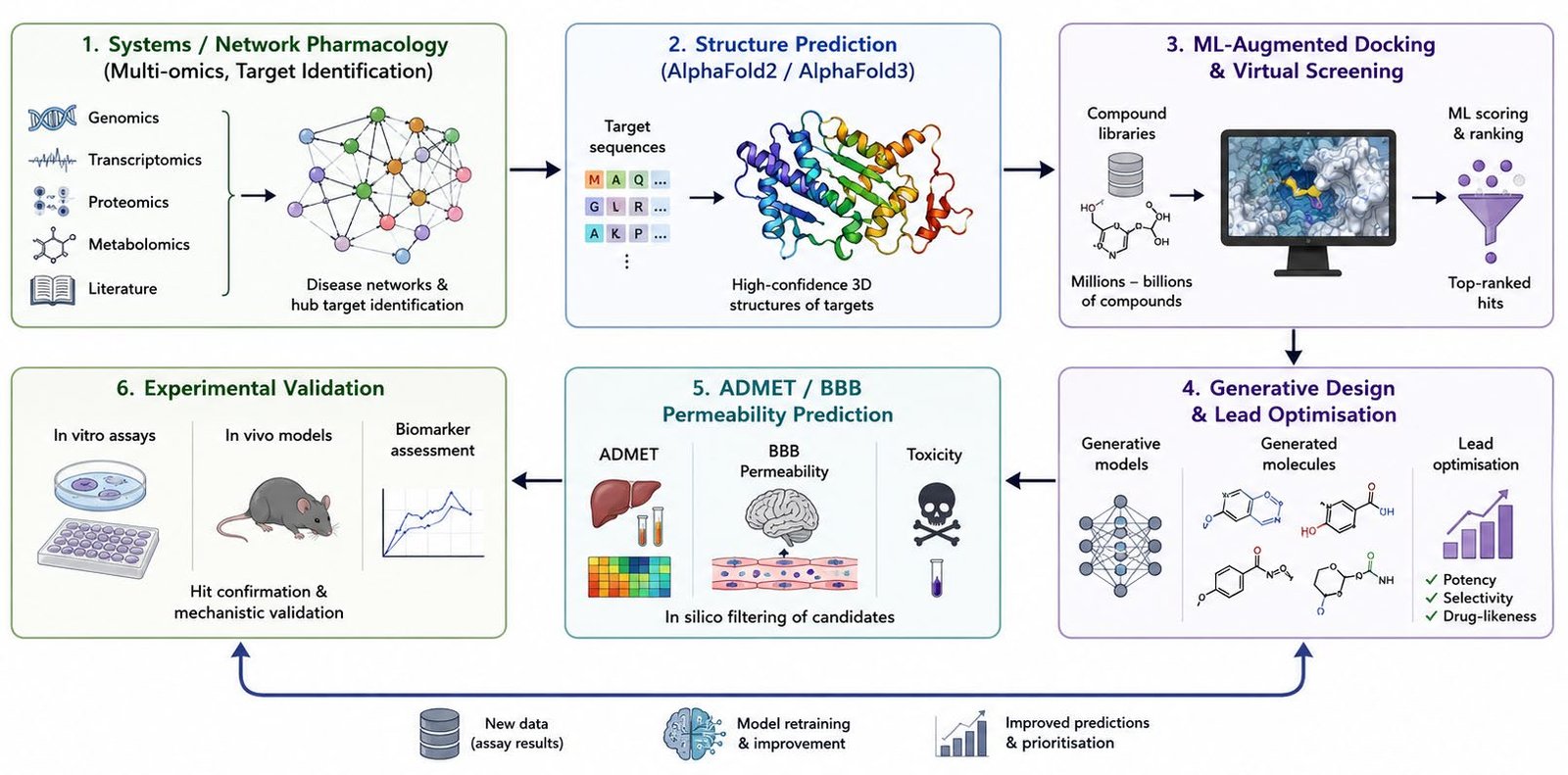
Neurodegenerative diseases such as Alzheimer's disease (AD), Parkinson's disease (PD), and amyotrophic lateral sclerosis (ALS) remain among the most therapeutically intractable areas of medicine, with decades of high clinical-trial attrition and an almost complete absence of disease-modifying therapies. Conventional drug discovery pipelines, built on a "one target-one drug" paradigm, have struggled to accommodate the multifactorial, network-level pathology that characterises these disorders. Over the past decade, artificial intelligence (AI) and machine learning (ML) have begun to reshape every stage of the discovery pipeline, from target identification and structure prediction to virtual screening and lead optimisation. This review synthesises current literature on integrating AI/ML, structure-based molecular docking, and systems/network pharmacology into a converging computational framework for neurodegenerative drug discovery. We discuss how deep-learning structure predictors such as AlphaFold have transformed structure-based design, how machine-learning scoring functions and generative models are accelerating virtual screening and de novo molecule generation, and how network pharmacology provides a systems-level lens for multi-target and drug-repurposing strategies in AD and PD. Representative case studies, including machine-learning-guided drug repurposing in Alzheimer's disease and structure-based iterative learning for α-synuclein aggregation inhibitors in Parkinson's disease, illustrate the translational promise of this integrated approach. We conclude by examining persistent challenges, including data heterogeneity, model interpretability, blood-brain barrier permeability prediction, and regulatory acceptance, and propose future directions for consolidating AI-driven, network-informed drug discovery pipelines for neurodegeneration.
References