Congenital Anomalies, Implementing Real-Time Deep Learning Detection in Underserved Perinatal: AI-Driven and 3D Anatomical Modeling, Pediatric Surgical Planning for Complex Birth Defects
DOI:
https://doi.org/10.64062/JPGMB.Vol2.Issue3.5Keywords:
- Congenital anomalies, deep learning, prenatal diagnostics, fetal ultrasound, pediatric surgery.
Abstract
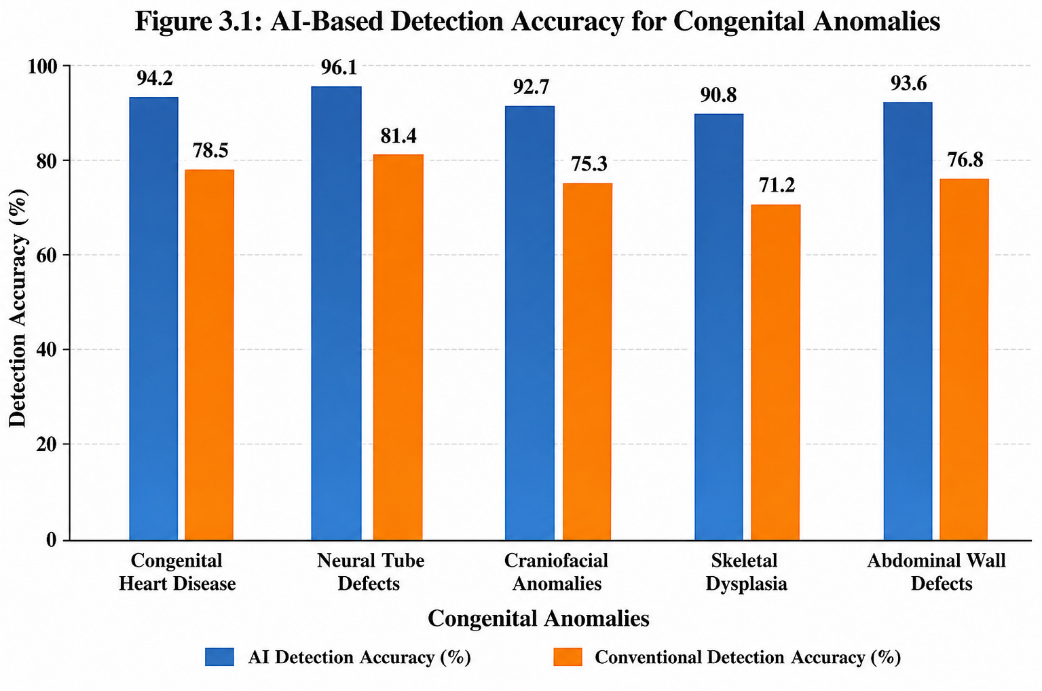
Congenital anomalies are a leading cause of deaths and disabilities during infancy. Prenatal diagnostic procedures play a pivotal role in the identification and timely treatment of congenital conditions. However, this technology is still limited in many underserved healthcare facilities. This paper examines the significance of artificial intelligence and machine learning technologies in the prenatal identification of congenital anomalies as well as pediatric surgery. The results revealed that AI-driven deep learning algorithms and systems proved more accurate in diagnosis than the existing prenatal diagnostic approaches. AI-integrated systems were also shown to be faster and less error-prone. Transformer networks outperformed all other machine learning approaches in this case. Besides, three-dimensional anatomical reconstruction aided in the planning of surgery and interventions for congenital birth defects.
References