Celosia cristata in Hyperlipidemia and Metabolic Dysfunction-Associated Steatotic Liver Disease (MASLD): Phytochemistry, Molecular Mechanisms, and Therapeutic Potential
DOI:
https://doi.org/10.64062/Keywords:
- Celosia cristata; hyperlipidemia; MASLD; NAFLD; hepatoprotection; flavonoids; saponins; AMPK; Nrf2; phytotherapy
Abstract
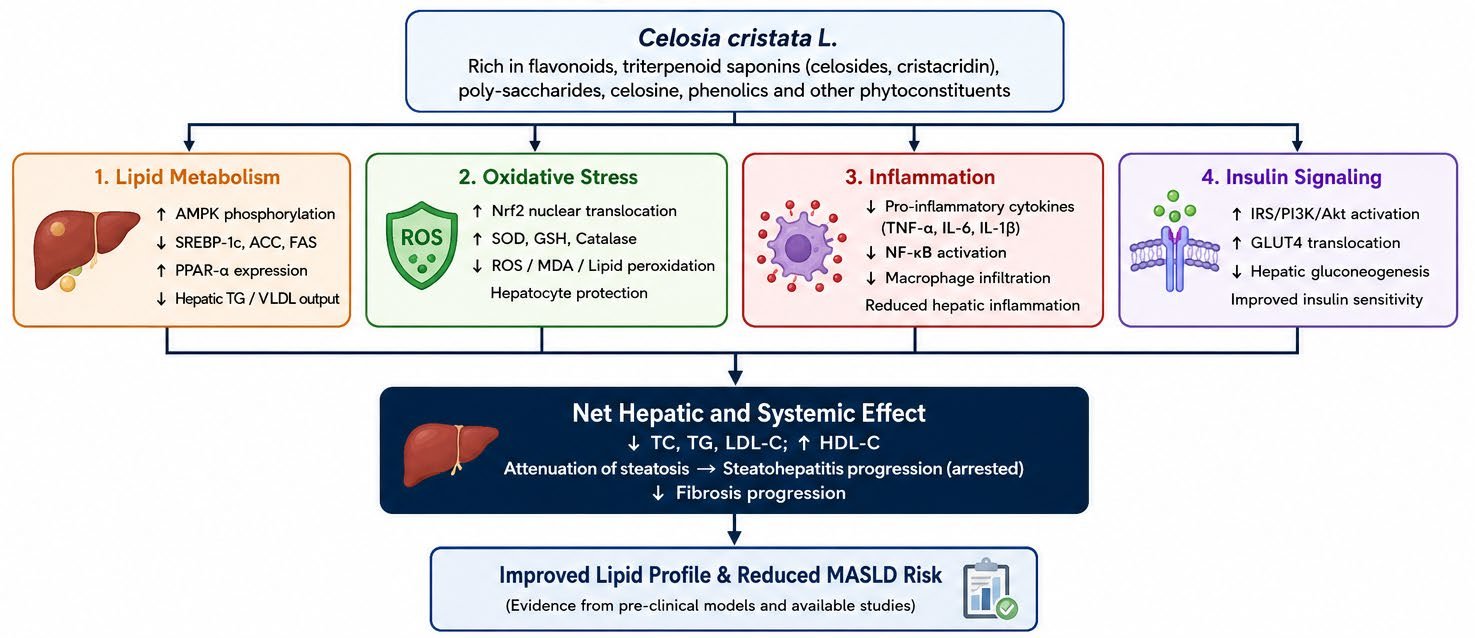
Background: Metabolic dysfunction-associated steatotic liver disease (MASLD) the nomenclature that superseded non-alcoholic fatty liver disease (NAFLD) after the 2023 multi-society Delphi consensus is closely intertwined with hyperlipidemia, insulin resistance, and the broader metabolic syndrome. Current pharmacotherapy remains limited, sustaining interest in plant-derived, multi-target agents. Celosia cristata L. (Amaranthaceae), the cockscomb, is a traditional medicinal plant with documented hepatoprotective, antioxidant, anti-inflammatory, and, more recently, anti-adipogenic and lipid-modulating properties. Objective: To synthesize the phytochemistry and pharmacological evidence base for C. cristata in relation to hyperlipidemia and MASLD, map documented and mechanistically inferred activity onto relevant molecular pathways, critically appraise the strength and gaps of current evidence, and outline a translational research agenda. Methods: A structured, though non-systematic, search of PubMed, Scopus, Web of Science, ScienceDirect, and Google Scholar (inception–June 2026) was performed using combinations of plant-, condition-, and mechanism-related terms, as detailed in Section 2. Results: Seventy-seven compounds predominantly flavonoids, triterpenoid saponins (celosins A–D, cristatain), polysaccharides, and phenylpropanoids have been isolated from C. cristata. A total flower extract has been shown, in vitro and in a high-fat-diet murine model, to reduce adipogenesis, intrahepatic lipid accumulation, and dyslipidemia while improving glucose handling; isolated saponins demonstrate hepatoprotection against chemically induced liver injury. Pathway-level data specific to MASLD-relevant nodes (AMPK, PPARα/γ, SREBP-1c, Nrf2/HO-1, NF-κB, PI3K/Akt) have not yet been generated for this species and are, in this review, explicitly inferred from class-level flavonoid/saponin pharmacology rather than presented as established fact. Conclusion: C. cristata is a mechanistically plausible but presently under-investigated candidate for hyperlipidemia/MASLD management. Priority needs include standardized extract characterization, pathway-level mechanistic studies in validated MASLD models, pharmacokinetic and safety profiling, and controlled clinical evaluation
References