Delayed Distal Splenic Artery Stump Pseudoaneurysm After Splenectomy for Blunt Trauma Successfully Treated with NBCA – Lipiodol Embolization: A Case Report
DOI:
https://doi.org/10.64062/Keywords:
- NBCA; Histoacryl; Lipiodol; transcatheter arterial embolization; splenic artery pseudoaneurysm; splenectomy; blunt abdominal trauma; visceral artery pseudoaneurysm
Abstract
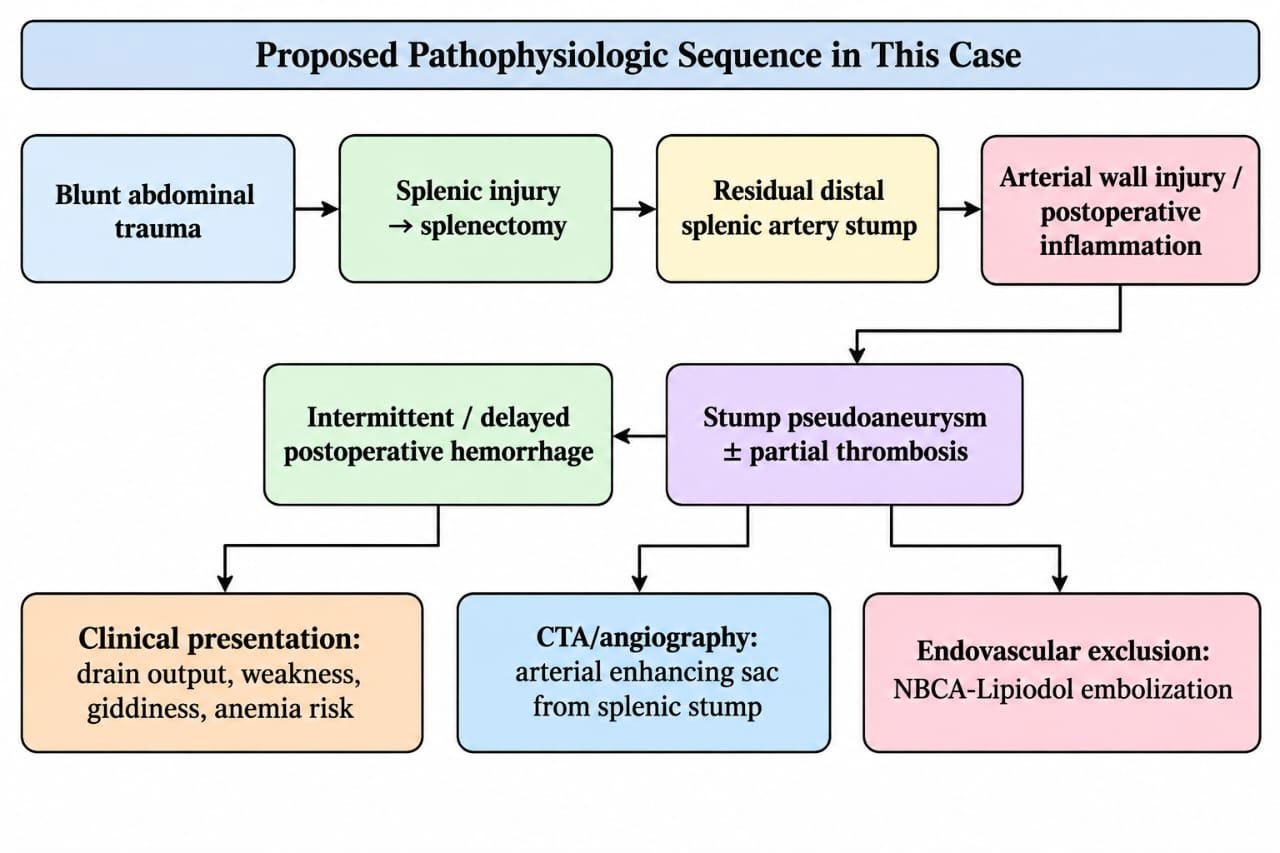
Background: Splenic artery pseudoaneurysm (SAP) is a rare but potentially fatal vascular consequence of trauma, iatrogenic or postoperative arterial damage, and pancreatitis. Regardless of diameter, a pseudoaneurysm presents a clinically significant risk of rupture because it lacks a full three-layer arterial wall, unlike a true aneurysm. Diagnosis and treatment planning heavily rely on catheter angiography and cross-sectional arterial-phase imaging. Case presentation: A 56-year-old man who had a splenectomy for traumatic abdominal injuries was readmitted around three to four weeks later. He developed giddiness, widespread weakness, and continuous drain output of about 400 mL. Contrast-enhanced CT showed postoperative splenic-bed changes with a centrally located vascular-enhancing focus consistent with a splenic artery pseudoaneurysm with partial thrombosis. A distal splenic artery stump pseudoaneurysm of about 18 × 20 × 20 mm was seen by selective celiac and splenic angiography. There was no active extravasation of contrast. N-butyl cyanoacrylate (NBCA; Histoacryl) was combined with Lipiodol in a 1:2 ratio (33% NBCA) to superselectively catheterize and embolize the feeding distal stump. Superior mesenteric artery angiography showed no retrograde filling through pancreatic collaterals, and completion celiac angiography revealed total exclusion. There were no immediate procedural issues. Conclusion: This case illustrates a rare delayed post-splenectomy splenic artery stump pseudoaneurysm and shows the value of liquid embolic treatment when detachable coils are unavailable and rapid, definitive occlusion is needed. Complete celiac and superior mesenteric angiography confirmed antegrade and collateral exclusion
References