Bacopa monnieri as a Multi-Target Therapeutic Candidate for Alzheimer's Disease: Pharmacological Evidence, Molecular Targets, and Clinical Perspectives
DOI:
https://doi.org/10.64062/Keywords:
- Bacopa monnieri; Brahmi; Alzheimer's disease; bacosides; acetylcholinesterase; amyloid-beta; tau; neuroinflammation; BDNF; cognitive function
Abstract
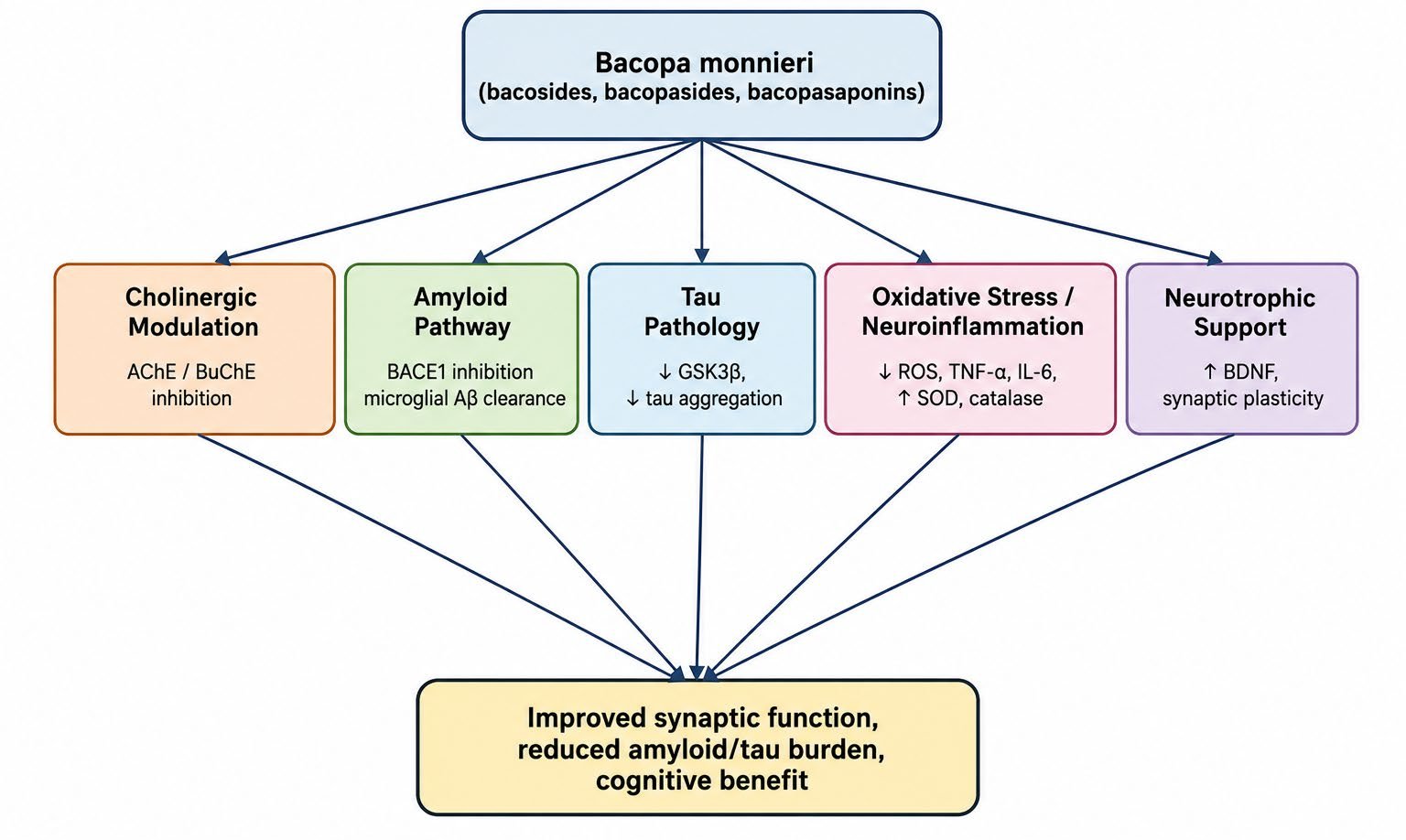
Alzheimer's disease (AD) is a progressive neurodegenerative disorder characterised by cholinergic deficit, amyloid-beta (Aβ) accumulation, tau hyperphosphorylation, chronic neuroinflammation, oxidative damage, and disrupted monoaminergic and neurotrophic signalling. Current pharmacotherapy, largely limited to acetylcholinesterase (AChE) inhibitors and the NMDA-receptor antagonist memantine, provides symptomatic relief without modifying disease progression, and recent amyloid-directed monoclonal antibodies and BACE1 inhibitors have shown only marginal or inconsistent cognitive benefit relative to their cost and safety burden. Bacopa monnieri (L.) Wettst., known in Ayurvedic medicine as Brahmi or a medhya rasayana, has emerged as a multi-target botanical candidate that can simultaneously address several of these pathological axes. This review synthesises pharmacological, molecular, and clinical evidence on B. monnieri and its principal bioactive constituents bacosides, bacopasides, and bacopasaponins across six convergent mechanisms: (i) cholinergic modulation through AChE and butyrylcholinesterase (BuChE) inhibition; (ii) attenuation of amyloidogenic processing via BACE1 inhibition and enhanced microglial clearance of Aβ; (iii) reduction of tau aggregation and phosphorylation; (iv) antioxidant, anti-inflammatory, and anti-apoptotic actions; (v) modulation of serotonergic, dopaminergic, and GABAergic neurotransmission; and (vi) neurotrophic support of synaptic plasticity via brain-derived neurotrophic factor (BDNF) signalling. Preclinical studies in transgenic and chemically induced rodent models demonstrate consistent improvements in spatial memory alongside reductions in amyloid plaque burden and neuroinflammatory markers. Clinical trials in healthy elderly adults and in patients with mild cognitive impairment (MCI) or AD report modest but recurrent benefits in delayed verbal recall and attention, although trial heterogeneity, small sample sizes, and variable extract standardisation limit the strength of these conclusions. Preclinical and early-phase human safety data indicate a favourable tolerability profile, with gastrointestinal complaints being the most common adverse effect. We conclude that B. monnieri represents a mechanistically plausible, multi-target adjunct for AD and outline priority directions for extract standardisation, pharmacokinetic characterisation, and adequately powered randomised controlled trials required before clinical translation.
References